Southeast Asia is entering a pivotal decade for clean mobility. Nationally Determined Contributions (NDCs), Economic growth, rapid urbanisation, and rising consumer interest in electric vehicles (EVs) are reshaping the region’s transport landscape.
Countries such as Malaysia, Thailand, Indonesia, and Vietnam have introduced ambitious EV roadmaps, signalling strong commitment toward lowering transport emissions.
The pace of this transition yet comes down to one practical question:
“Can charging infrastructure scale quickly and reliably enough to support widespread EV adoption?”
Today, the answer remains mixed. While national EV policies are advancing, many markets face early-stage challenges — such as long payback periods, limited bankability, low utilisation rates, and uneven charger distribution.
This gap between EV ambition and infrastructure readiness underscores the need for more robust, financeable charging business models.
Saxon Renewables’ EVolve Grouped EV Charging Carbon Project(Verra VCS ID 5416) addresses this gap by enabling charge point operators (CPOs) to generate verified carbon credits from real EV charging activity.
By linking carbon monetisation directly to charging operations, EVolve helps close financing gaps that often slow infrastructure rollout — unlocking faster, more scalable EV adoption across Southeast Asia.
Why Southeast Asia Needs a Better Way to Scale EV Charging
Transport accounts for approximately 15 percent of global greenhouse-gas emissions. One of the largest and fastest-growing sources of emissions.
EVs offer a clear pathway for reducing transport-related emissions, but their adoption can only grow as quickly as charging infrastructure allows.
Across the region, CPOs consistently face these three challenges:
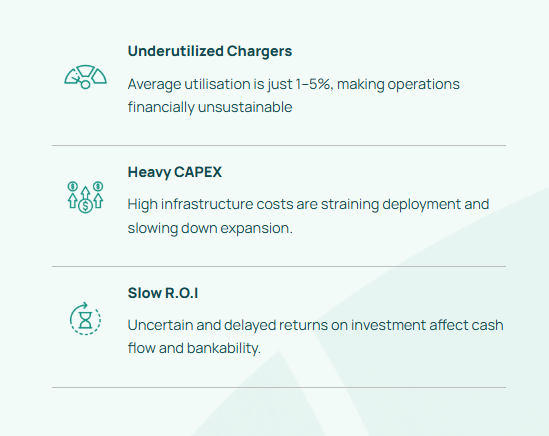
Without a robust financial mechanism to support deployment, EV charging risks becoming a bottleneck to national EV ambitions.
EVolve: A Verra‑Registered, Scalable Framework for EV Charging
Saxon’s EVolve Programme is formally registered under the Verified Carbon Standard (VCS) as Project ID 5416, using the VM0038 methodology. This ensures adherence to internationally recognised carbon-accounting standards.
Why a Grouped Project Structure
EVolve is developed as a grouped carbon project, enabling continuous expansion over time. New EV charging systems can be added directly as Project Activity Instances (PAIs) throughout the project’s 2024–2031 crediting period.
This structure enables:
- Faster onboarding of multiple CPOs across Southeast Asia
- Lower administrative and validation costs for each participant
- Centralised, Verra-compliant MRV (Monitoring, Reporting, Verification)
- Flexible, scalable participation for operators of all sizes
This framework allows EVolve to evolve. Supporting the region’s growing charger ecosystem with efficiency and consistency.
How EV-Charging Emission Reductions Are Measured
Verra’s VM0038 methodology provides a transparent, data-driven framework to quantify the climate benefit of EV charging. It compares emissions from an equivalent trip made by an internal combustion engine (ICE) vehicle with the electricity consumed by an EV.
The core equation is straightforward:
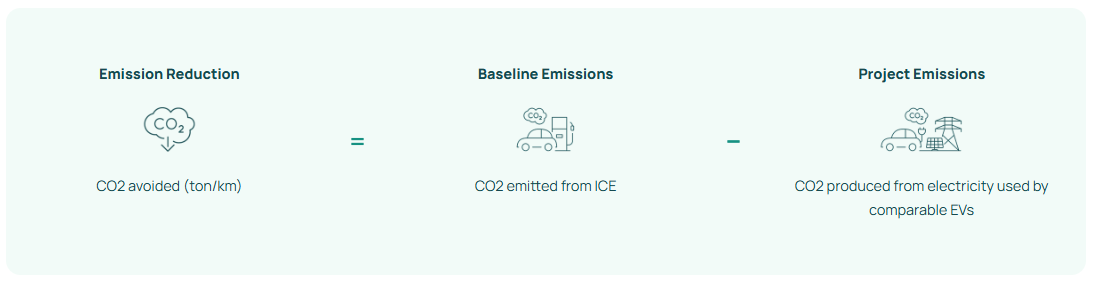
Baseline Emissions
CO₂ that would have been produced by an equivalent ICE vehicle travelling the same distance.
Project Emissions
CO₂ associated with the electricity consumed by EVs, calculated using national grid emission factors.
Emission Reduction (CO₂ avoided)
The difference between the two represents the verified emission reductions, which are issued as Carbon Credits once validated and verified.
Verra confirms that leakage is negligible for this project category and that all assumptions follow conservative methodological guidance.
This ensures EVolve’s credits are grounded in real, metered charging data, not estimations. Giving corporates and CPOs high confidence in the environmental integrity of each credit issued.
How EVolve Bridges Financing Gaps in EV Infrastructure Deployment
A key value proposition of EVolve is its ability to enhance the commercial feasibility of EV charging networks. This is an ongoing challenge for operators in emerging EV markets.
In early-stage EV markets, it is a norm to see slow utilisation growth. This delays revenue recovery and extends payback periods. EVolve directly addresses this challenge by allowing CPOs to generate carbon-credit revenue from the climate impact of EV charging.
The Commercial Value of Carbon Revenue for CPOs
- Provide an additional income stream beyond charging fees
- Reduce CAPEX and OPEX pressure, especially when utilisation is still low
- Improve feasibility for emerging or secondary locations
- Support wider deployment in line with national EV and clean-mobility targets
EVolve aims to onboard up to 30,000 charge points by 2030, making it one of the region’s largest aggregated EV-charging programmes.
As utilisation increases, the volume of verified emission reductions grows. This creates a self-reinforcing model, where scaling infrastructure leads to greater climate-finance benefits.
Environmental Safeguards and Sustainable Development Benefits
The VCS Project Description outlines strict environmental and social safeguards across all PAIs:
- Chargers are installed in existing built environments, avoiding land-use change or ecological disturbance
- No displacement of communities occurs
- All installations adhere to host-country regulatory requirements.
- A formal grievance mechanism is in place, allowing stakeholders to raise concerns and ensuring transparent resolution processes.
The project also contributes to key UN Sustainable Development Goals (SDGs), including:
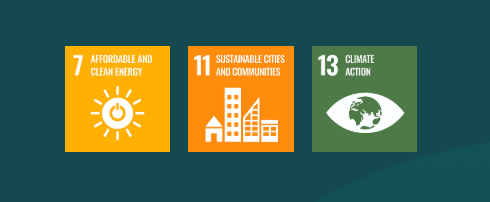
These co-benefits reinforce EVolve’s role as a responsible and high-integrity climate solution.
Why EV Charging Carbon Projects Matter for Asia’s Transition
Scaling EV charging is essential for enabling cleaner mobility systems across Southeast Asia. Carbon projects like EVolve help accelerate this transition by:
- Strengthening the financial feasibility of charger deployment
- Helping operators overcome financial challenges
- Providing verified, measurable climate data to corporates and governments
- Supporting national roadmaps and emerging Article 6 cooperation pathways
Rather than replacing existing policies or incentives, EVolve complements them. Serving as a practical bridge between climate finance and real-world infrastructure needs.
Conclusion
Southeast Asia’s clean mobility transition depends on solutions that are credible, scalable, and grounded in measurable climate impact. Saxon Renewables’ EVolve Grouped EV Charging Carbon Project delivers a Verra-certified framework that transforms EV charging activity into a climate-aligned revenue stream while accelerating the region’s infrastructure expansion.
As the first grouped EV-charging carbon project of its kind in Southeast Asia (excluding Singapore), EVolve will progressively onboard CPOs across Malaysia, Vietnam, Thailand, Indonesia, and the Philippines, with expansion planned toward broader Asia-Pacific markets.
By combining rigorous methodology, regional scalability, and a market-driven financing model, EVolve helps close the gap between national ambition and infrastructure readiness.
One charging point, one kilowatt-hour, and one verified emission reduction at a time.